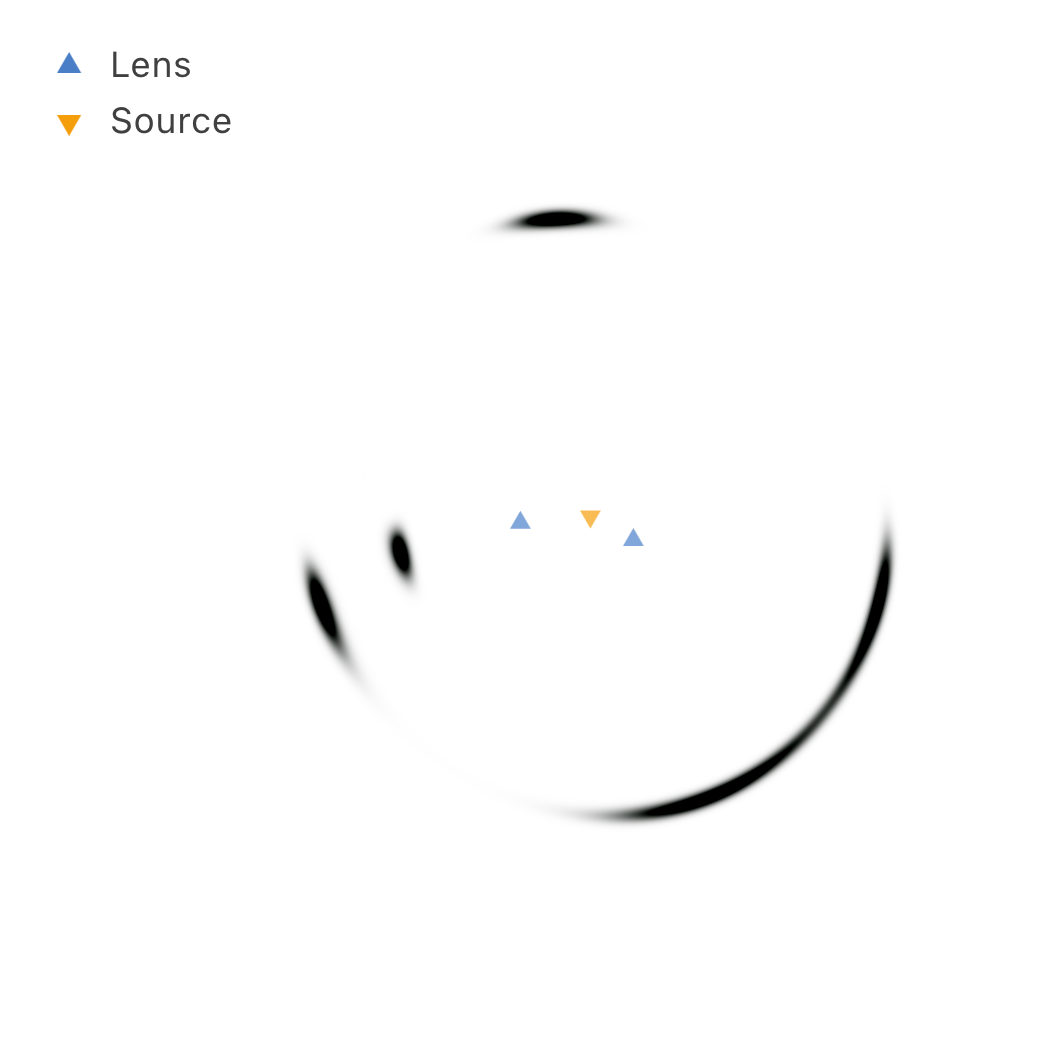
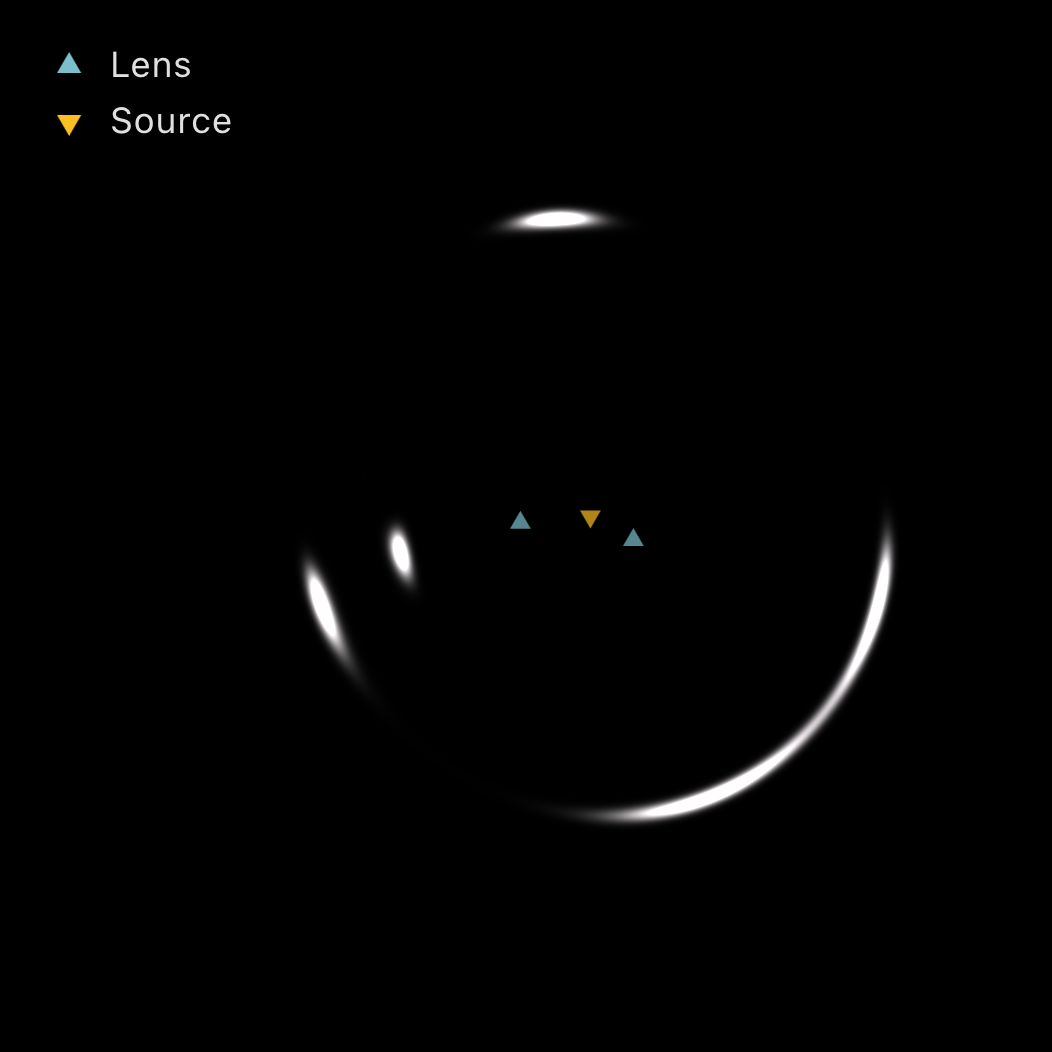
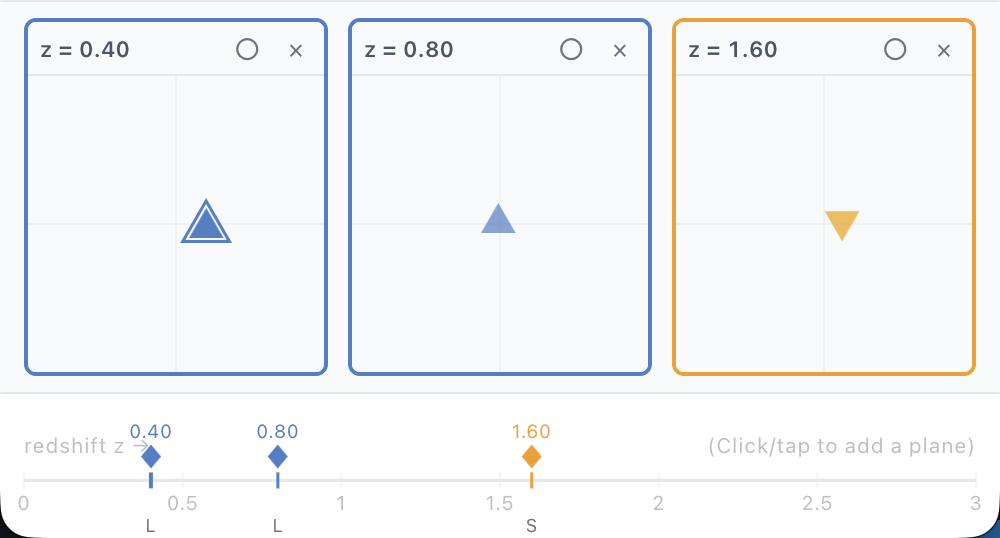
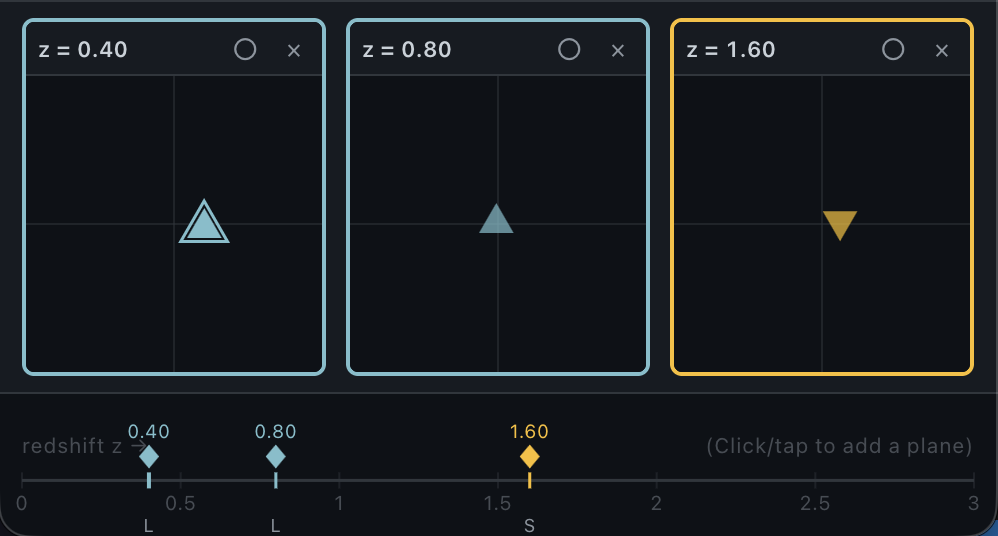
3. Multiplane lensing recursion
The scene is a set of planes, each at its own redshift, sorted from nearest to farthest. For each pixel, a ray is traced from the observer through the planes in order. The ray seen at angle $\boldsymbol{\theta}$ on the sky (the pixel’s position, in arcsec) reaches plane $j$ at angular position (Schneider, Ehlers & Falco 1992)
Multiplane recursion
\(\boldsymbol{\theta}_j \;=\; \boldsymbol{\theta} \;-\; \sum_{k\,<\,j} \frac{D_{kj}}{D_j}\;\hat{\boldsymbol{\alpha}}_k\left(\boldsymbol{\theta}_k\right)\)
| Symbol | Meaning |
|---|---|
| $\boldsymbol{\theta}$ | Angle at which the ray is seen, fixed for each pixel (arcsec) |
| $\boldsymbol{\theta}_j$ | Angular position of the ray at plane $j$ (arcsec) |
| $D_j$ | Angular diameter distance from the observer to plane $j$ (§2) |
| $D_{kj}$ | Angular diameter distance from plane $k$ to plane $j$ |
| $\hat{\boldsymbol{\alpha}}_k(\boldsymbol{\theta}_k)$ | Total bending angle from the lenses on plane $k$, at the ray’s position there (§5) |
The factor $D_{kj}/D_j$ turns the bending at plane $k$ into a shift in position at plane $j$. Each plane bends the ray at the position the earlier planes have already moved it to, so the effects of two lens planes do not simply add.
Every object is either a lens or a source, whatever plane it is on. Only lenses bend rays; sources only emit light. A plane can hold both. The ray’s position on a source’s plane is that source’s $\boldsymbol{\beta}$, where its brightness is evaluated (§6).
A scene can have up to 8 planes, 32 lenses and 32 sources, of which 4 can be pasted images (hidden objects do not count; some GPUs allow fewer). Objects or planes beyond that still appear in the scene but are not drawn, and a warning on the image says how many.